Monday, 27 May 2013

Ethel

A close call. Source: RPNYC archive
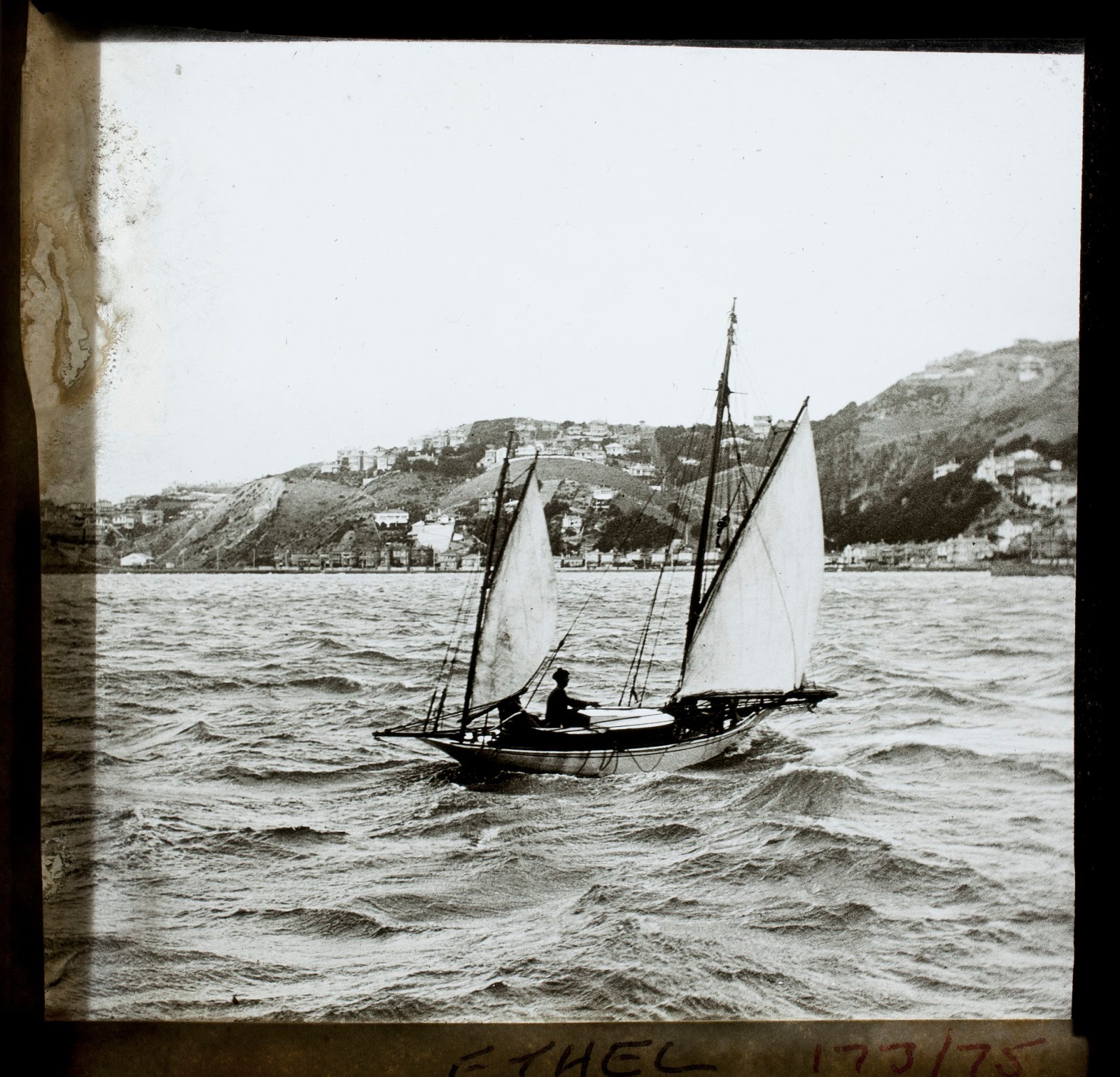
Some boats through no fault of their own seem to attract an aura about themselves. Every time a sail is hoisted, there is something in the air that says: "something interesting/funny/scary/tragic is about to happen". Such a boat was the Ethel. I've no idea how she got into the pickle snapped from the dockside pictured left, but it appears to have happened in 1914. As an aside, the collier Hercules was torpedoed and sunk in 1917.


Ethel was built by Charles Bailey Sr. in Auckland and launched 1884. She probably initially had a plumb stem. The clipper bow she shows in these photographs bears the hallmarks of a later adaption. At 33' LOA and 7',8" beam, she was a handy little cruiser, and raced in the 3rd class fleet at Port Nicholson Yacht Club..


Source: Wellington Museum of City and Sea
Ethel was purchased and brought to Wellington by two young brothers T & Kenneth Cole, in 1909. They soon converted her from a cutter rig to a yawl - a fashionable setup for Wellington yachts from about 1900 to 1920 which were intended for a lot of cruising. The image of Ethel (still cutter rigged) here with all of the women on board is a fitting one to this tale.


Kenneth Cole in uniform
In May 1912 Wellington was scandalised to read in the morning papers that the lads and a couple of friends had, on a Sunday, taken four women unchaperoned out for a sail and picnic on Ward Island. To make matters worse, two of the women were barmaids! Unfortunately, whilst picnicking, a southerly squall came through, followed by driving rain. In trying to get back aboard the Ethel, the dinghy was lost, and the party was stranded. The Ethel was sailed back to Wellington by two of the party to raise the alarm. The castaways were picked up by the Siren (happy name!), and taken aboard the Naomi, dried and fed. A full article of the events, along with cartoons may be read here.


The Cole Brothers sold Ethel in 1914 and joined up. Kenneth, a winner of the Military Medal, in January 1918, was killed at the Somme in April 1918.


Ethel  changed hands twice during the war period. A great deal of mirth was taken at the expense of her handling - particularly in the Clyde Quay marina, where is was felt positive that she only came in at full tilt, relying on banging against another vessels and eventually the breastworks to bring her to a halt. See here and here.


Source: Wellington Museum of City and Sea
In 1916 Ethel was purchased by an Australian veteran of the war, L. Hill.

Although a member of the Port Nicholson Yacht Club, Hill was a loner, and only ever sailed Ethel single-handed. He lived at his shed at Clyde Quay, and spent all of his time either in his shed or at sea.

In December 1918 he took off for several months to the Marlborough Sounds. In June 1919, he left Port Underwood for the return to Wellington, but after several weeks it was realised he hadn't arrived.

Wreckage of a yacht had been spotted North of Wellington at Otaki. It was worried that Hill was lost until news was received eventually that he had been blown South of the Wellington entrance and had for five days struggled to get Ethel to weather and get inside the channel. Exhausted, dehydrated and starved, he decided to drive Ethel ashore at Palliser. She was a complete wreck. He managed to get ashore and find a farmhouse, where he was fed and looked after for several days before he got a ride on to Featherston. From Featherston, he decided to walk back to Wellington - a matter of more than 60 kilometers. It appears he took his time about it, and odd jobbed here and there before deciding to go to Auckland instead. What happened to him after that is a mystery.

Source NZ Yachtsman 16 December 1911


Source: Wellington Museum of City and Sea

Source: Wellington Museum of City and Sea

Wednesday, 22 May 2013

Treasure Island

There's nothing quite like a blat across Cook Strait. It's always different and there's always a challenge of some kind or another. Lots of people take their boats across from Wellington to spend a holiday. Sitting around and idly fishing or having parties is not really my thing though - not for days on end anyway. I've always preferred the sailing bit.

If you're similarly inclined, and find yourself pottering about over there with not much to do, you might want to check the veracity of the story below. It is taken word for word from the Yachtsman magazine - a very good publication put out by the Evans Bay Yacht and Motor Boat Club for several years during the mid 1930s. If nothing else, it provides a nice little fireside read.

I've added some illustrations.


TREASURE TROVE

(Told by "Perry" at whose request all personal names have been changed.)

There is a Treasure Island in Marlborough Sounds with buried gold to the estimated value of 400 pounds. The Island is shown on the charts as Cooper Island and it is situated between Cabbage Bay and Long Island in the Northern entrance. The charts show the island as being without any anchorage or cove, but in this respect they are wrong as I shall show. There seems little doubt but that the treasure still lies where Laurence Crosbee buried it years ago.

Chance led me to the discovery which, aided by coincidence led to our search for the gold and to the tragic death of one of the searchers.

The Twins as shown on Google maps
Christmas (1929) we were anchored off the Twins in the Northern entrance fishing. Nearby, lay a small island, so I rowed across to it. On coming close I discovered a cleft or channel in the cliff face with deep water. This led me into a tiny landlocked bay. The entrance was only fifteen feet wide, and being on the angle could only be distinguished on near approach. The island looked as though it might once have been the crater of a volcano. Now, however, it was overgrown with stunted bush. In one corner of the tiny bay was a sandy beach and a few square yards of level land. At the back of this the land rose in sheer cliff to some fifty or sixty feet in height.


Gold miners at Endeavour Inlet. Source National Library of NZ
It was Peter who first mentioned the Treasure, having read about it in "Petersen's Adventures in Marlborough". In 1868, according to this old book (printed in 1875) gold was being mined near the head of Endeavour Inlet. Every few weeks the gold was brought into the tiny hamlet of Endeavour to be taken to Picton. One night a considerable sum lay in the small store and Post Office. It was stolen. There was a great hue and cry and eventually suspicion fell on one  "Sailor" Crosby, a ne-er-do-well hanger on who was a boatman during the whaling season. Crosby had a sailboat and was absent for a long time on the night of the robbery. Crosby hotly denied the charge, but was sent to Picton (then capital of Marlborough). He was tried before Mr Justice Grove. Seeing the case go against him, Crosby tried to obtain a release by promising the Court to return the gold which he said he had buried on an island. The scandalised judge instantly sentenced him to 15 years. Attempts were made for a while to locate the gold but , as far as it is known, without success.

Mt Cook Prison in 1896. Demolished 1931. Source Te Ara
As to its correct whereabouts, it was Donald who supplied the final clues. He had been working on the Mount Cook Prison (Wellington) demolition job. During the demolition many strange things were found in those six foot walls. There was scarcely a cell that didn't have its loose bricks with space for hoarding trinkets, letters and diaries. (See Evening Post file for article on these discoveries.) An aquiantance of Donald's, one Richards, working nearby, fished out an old envelope with a letter inside. After glancing at it he tossed it over to Donald remarking that it looked as though a yachtsman had been in the jail. Richards was also a yachting man. Donald looked at the paper which consisted of a letter with a plan on the back. On reading it through later he found that the actual letter had no reference to the chart on the back, which was just the map of an island. Knowing Peter was keen on anything unusual Donald gave him the letter. The letter was addressed to Laurence Crosbee.

It is unnecessary to tell at length how we eventually stumbled on to the fact that Laurence Crosbee, the prisoner in Mt. Cook, was the "Sailor" Crosby who buried 400 pounds in gold, and how it dawned on me that the map on the back of the letter was really a chart of Cooper Island. Sufficient to say we came to the conclusion that the gold was on Cooper Island buried five feet on the beachside of a large cabbage tree. Unfortunately others became aware of our discovery.

Poor Crosbee must have drawn the sketch to aid his failing memory and then died in jail.


Motungarara (Cooper Island) on Google maps
We were able to get away on an evening in February 1931, for the Sounds, Donald, Peter, and myself, in the yawl belonging to Peter. We had a splendid run in the S. E. breeze across the Straits, and reached the Nortern entrance about 6a.m. We took about two hours in the falling breeze to back up to Cooper Island against the tide. When we reached the island the wind had fallen away altogether and we had to tow the yacht into the entrance. The bay was just as I had seen it several years before. the high bush-clad cliffs, the tiny beach - and there, just back from the beach on a small plot of level land was Laurence Crosbee's cabbage tree. As quickly as we could we moored the yacht, furled sails, and without waiting for breakfast we tumbled ashore armed with a pick and a spade. We estimated five feet from the palm and dug. It was hard work, for the sun was hot.

We had dug about a foot when we heard the beat of a motorboat engine and suddenly through the entrance nosed a large boat. We recognised the launch. It belonged to Joe Foster and Spud Laws (not their real names of course). We paused from our work as she came in. Standing for'ard to drop the anchor we saw Richards, the fellow who gave Donald the chart. Soon they were ashore looking at the hole we had started to dig.
"Just in time," said Laws with a laugh. Peter asked him what he meant, whereupon Foster said that they had come for their share of the gold as it was just as much theirs as ours. Furthermore they had waited for us in a nearby cove giving us time to start digging in order to see exactly where the gold lay. They wanted to be fair and were willing to split fifty fifty.

Peter said he'd see them in hell first and with that the fight was started. The fight was long and tough and in the end Foster and his two pals drew off to nurse their bruises. We were not unhurt ourselves and sat down alongside our hole to glower at our rivals. After resting Laws came up and said that they weren't going to budge until they had got a share. We told him to go to blazes and started digging. The time was now about eleven thirty. Suddenly we heard a crashing sound and a loarge boulder flew past Donald who was loosening the soil with the pick. We looked up the clif and saw Peter on top.

"Keep clear of that hole or else I'll roll some bigger bricks down," he yelled. With that he rolled a few more down to show us how. We felt wild, especially when we saw the grins (somewhat twisted) of Richards and Laws.
At this moment fate took a hand and the tragedy happened. The bounding boulders must have loosened the cliff for, with a roar that made the ground tremble, the side came down in a cloud of dust. A large stone caught me in the back as I turned to fly and knocked me into the water. Peter and Donald were to one side and were able to dodge away. Laws and Richards at the other end of the beach were safe.

Scene of the action from a near-contemporary chart
But Foster we found half buried in the land-slide - dead. The tragedy sobered us. More earth was falling, so we returned with poor Foster's body to our craft in the launch's dinghy. Our dinghy was under the earth.

We hurried to Picton: the launch with the yacht in tow. On arrival we heard of the terrible earthquake that had happened in Napier at the same time as the landslide. We did not know until then that an earthquake had happened. Among the large toll of death of earthquake victims the inquest on poor Foster passed unremarked especially as we did not refer to the treasure.

So the gold still lies on Cooper Island buried deeper than Laurence Crosbee ever dreamed it would be.

(footnote. From the latest charts and maps Cooper Island is shown as Motungarara Island, and Cabbage Bay as Onehunga Bay.)


...And that's the article in full, including the footnote. Anyone fancy a treasure hunt??


Wednesday, 8 May 2013

Pet


Pet's lines. Source: NZ Yachtsman 28 October 1916


Pet was built by Charles Bailey in Auckland, and was launched in 1877.


Pet at Thorndon

She was of an unusual shape - in an era of slab-sided vessels and plumb stems, she had quite a pronounced tumble-home and a ram bow. This made her both longer and wider at the waterline than at deck level.

This construction was to cheat a class racing rule of the day which was based on measuring the beam and length of a boat at deck level - a smart little trick to make the boat bigger where it matters and therefore have a faster theoretical (and practical) maximum hull speed. Needless to say, like all other rule cheaters, it didn't take long before a new system was arrived at in the eternal tussle between the designer and class handicappers.

Charles Hill in 1916.
Bailey laid the keel and framed up the boat "on spec", and the structure hung in the rafters of his workshop for some time before being purchased. She was unnamed, and become known in the yachting fraternity as "Bailey's Pet". The nickname stuck when she was purchased by Charles Hill in 1877. Hill was a hatter by trade, and was one of the founding members of the Port Nicholson Yacht Club in 1883.

Hill had Bailey plank her up, and fitted out as an open centreboarder, and after a couple of races in Auckland, brought her to Wellington, where she easily beat her competition.

In 1879 Charles Bailey arrived from Auckland with his recent build Toy, a lightly built open boat of cedar with a clear finish, and sporting the latest in light wire rigging. Toy won the second class race of the annual Wellington regatta. Hill took advantage of Bailey's presence to do some work on Pet - having her half-decked over, and a small counter added. Pet was entered in the first class race but had to withdraw when her rigging failed.

Red Jacket in Christchurch
1880 was a big year for Pet, and secured her fame as the classiest racer in town. She was entered in the Anniversary Regatta for second class vessels, which was greatly anticipated for the clash with Red Jacket, built in Sumner about 1865. The race was postponed due to rough weather. A week later, Pet led the fleet, Red Jacket 50 yards behind, when the wind died away and the race postponed once more. The next attempt was got away in rough weather, and one of the mark buoys came adrift. It was once again a "no race". However, the Regatta Committee in a surprise move, decided to award the prize to Pet, as it felt she was the better performer. Furthermore, the Committee decided to run another race to decide second place!

The owners and crew of the Red Jacket of course would not abide this, and laid down a one-on-one challenge in the newspapers. The Regatta race for second place took place, with Pet, although banned from entering, also going around the course. Red Jacket crossed well ahead of the fleet, including Pet. Hill may have been up to some clever gamesmanship here, but there was no denying now that nothing would be settled until a one-on-one private race was sailed.

Terms were agreed, and the race was to be around a moored mark boat at the head of Barret's Reef at Wellington Heads, around Somes Island and back to Queen's Wharf. The event was much discussed in the local newspapers, and a great deal of money was laid out in the pubs - mostly at even money. Pet won, and won easily. She was five minutes ahead at the mark boat, and won by 30 minutes, Red Jacket having to bail hard after starting her garboard planks on the beat up the channel in rough seas.

Later that year, Pet was shipped across to Nelson for a challenge race against the brand new yacht Isca. She also won that easily; The proud new owner of the expensive Isca so disgusted he never bothered racing again, and sold his boat. (Read Isca's story here).

Pet at her moorings ca. 1890
Pet remained the cream of the fleet until the arrival to Wellington of Robert Logan's Jessie Logan in about 1890. Luckily for Pet's racing career in Wellington, Jessie Logan was purchased and spent the next 15 years in Nelson, before suffering the indignity so common in those days of being converted to a launch.

Pet had a well-known, though somewhat secret internal ballast system when she was a centreboarder (see the ballast systems of Pet and Red Jacket below). To stiffen her up and make her better fit for regular club racing, deadwood was added to her keel and external lead ballast attached some time around 1888.

Around 1900 Pet was retired as a racer, and converted for use as a fishing smack at Warehou Bay north of Wellington, She was then converted to a motor launch and used for fishing a little further North at Paremata. She was wrecked while pursuing this work during the 1930s.

Pet's moveable ballast system


Red Jacket profile and ballast system


Pet readied for external ballast ca. 1888


Pet as a launch at Paremata in 1916

Tuesday, 16 April 2013

Isca - A little ship that could

Isca's lines. Probably taken off the hull.
Found in Jack Maddever's shed at Clyde Quay,
 and now in the posession of Bruce Askew.
The Isca was built at Clyde Quay, Wellington in 1880 to a Dixon Kemp design by T. R. H. Taylor, for A. S. Collins of Nelson. Her build was a single skin of 1" kauri on Australian Blackwood. She was not a success in Nelson, being down at the head. The smaller second class centreboard racer, Pet, was shipped across from Wellington for a challenge race, and beat the Isca easily. Collins lost interest and the Isca lay idle until Professor R. J. Scott purchased her for racing with the newly-formed Port Nicholson Yacht Club.

Scott tweaked her up, importing a new douglas fir mast from Australia, adding a lead shoe to the counter to bring her nose up a bit, and added 3 1/2 tons of external ballast. Her performance improved somewhat, and she won a few races in Wellington, though against inferior boats - mostly converted boats never built for speed in the fist place, or racing boats imported and too light to excel in Wellington conditions. He took her to Lyttelton in 1884 to compete the anniversary regatta there, but was defeated. The Isca was taken over by E. C. Batkin, who again took her south to compete the 1886 regatta where she emerged victorious in a strong Easterly. If nothing else, she covered a lot of sea miles in her time.

Source: NZ Yachtsman 27 November 1915
The Isca was 38 feet LOA, 32 LWL, with only six feet beam, and carried a 14 ft bowsprit. With her large club topsail set (see left), her rig stood 55 feet.

She was a yacht of the old gentlemanly school, immaculately kept during her time in Wellington, and campaigned hard. She was a well-known and popular vessel, as were her owners and skippers, but she was never the racer many claimed her to be. However, she had the reputation of being quick in stays, and her skippers used this to advantage when working the tricky shifts on the Hutt coast off Ngauranga and Kiawharawhara. Her victories against other first division boats were generally on time allowance, and she even had trouble beating the better quality second class yachts across the line.


Isca did however, have one moment of undeniable racing glory, which unfortunately also ended in her destruction.


Source: NZ Yachtsman 02 Sept. 1916
Isca had been entered in the Wellington regattas, but the best she had ever got was second. in 1892 she was beaten out by Mapu, and early February 1893 she was beaten by the Maritana on the run down from Korokoro. The Isca losing and resetting her topsail three times! The Rona, the latest thing in yacht racing had just been built that year to Alexander Turnbull's order by Robert Logan. She was en route to Wellington when the 1893 regatta took place, and had proved herself a speedy vessel in Auckland.


The Rona was a 5-rater, desgned by G. L. Watson. The design had already proved herself in the shape of Valentine. Rona was part of the new breed of yacht - firmer bilges, more beam, less forefoot, long shallow keel - which lead to less wetted surface area and more boyancy. Rona by today's standards may have slack bilges and a large wetted surface area, but boats like her were light in comparison with the "Cheesecutter" section of Isca's type. With a beam of 7',4", and overall length of 44 feet, she had a far longer effective waterline

Rona won her first race in Wellington in late February 1893, Maritana second and Isca third. This was the second race of the PNYC first class season. Rona came second behind the Maritana in the first class race at the Wellington regatta in 1894 on corrected time after a close finish which included the Isca.

Atalanta - Stole Rona's thunder when she arrived in 1895.
Source: Alexander Turnbull Library
Robert Logan made the trip to Wellington to tune up the Rona for the 1895 Regatta, and she beat all of these boats. All were surpised however, by the Atalanta. who crossed the line first, but was later disqualified for carrying a larger mainsail than rated for in the regatta. Isca was nowhere.


Source: NZ Yachtsman, 27 November 1915
The 1896 Regatta saw both the Rona and Isca racing in the second class. A blustery Northerly blew, and the other three vessels in the race, Waiwetu, Mahina, and Mapu had to withdraw. Isca and Rona fought on, each sniffing their chance. They each passed the final mark at Korokoro in company, from where it is a straight drag on a reach to the finish off Queens' wharf (there was not so much reclaimed land in those days). It was felt that the Rona was making the better of it - Isca, in full sail, had started her planks under the press, and there appeared to be more water in the boat than out. Rona looked set to pull away and was felt by spectators to be sailing a better course when a gust caught her - splitting her mainsail and her foresail. The gooseneck on her boom also carried away. Both yachts crossed the line to great applause and cheering from the crowd crowding the waterfront - Isca having won by 27 seconds.

Rona went back to her moorings, while Isca, on the verge of sinking, turned straight around and went on the hard at Evans Bay. She never went back into the water.

Source: NZ Yachtsman, 02 May 1914
Isca sat and was finally broken up in 1897/8. Her lead was purchased by a plumber at Thorndon, who made nails of it. Her mast went into the Kotiri, recently built, as did most of her deck fittings and her canvas. Kotiri's mast had been found dangerously tender on her first foray into sailing during the 1898 regatta. That mast proved worthy of the import back in 1883, as it was still in good service at least into the 1940s. It had been put under plenty of pressure during its time!


Source: NZ Yachtsman 04 December 1915


Isca in 1892. Source: Alexander Turnbull Library


Tuesday, 9 April 2013

Robert Julian Scott Part 2


Source: Gavin Pascoe
Just linking back to the previous post on Scott, I thought it would be nice to publish this image, which he drew on the reverse of a letter to a friend in 1899, thanking him for putting his name forward for membership of the Wellesley Club, Wellington. It shows Zephyr going through a gybe in some heavy weather off Akaroa in 1893. No doubt a shared experience.

By the way, as an aside, Scott was first cousin to Falcon Scott of the Antarctic fame.


Boojum
The drawing below is another ink sketch of a design for knocking about. Not very much is known about her other than the name "Boojum" and that she was actually built. The name comes from Lewis Carroll's The Hunting of the Snark, a boojum is a being which makes people disappear. Quite a playful and slightly sinister name for a small boat designed for ease of single-handed sailing.


Source: Gavin Pascoe


Kia Ora
Kia Ora was a 5-rater and a very sucessful racer in her day. She shouldn't be confused with the Bailey and Lowe-built vessel which famously was attempted to cross the Pacific (against both the law of the day and good sense) in 1903.

She was built for J. B. Collins to be based at Lyttelton; and raced her first major regatta at Akaroa in 1898, where she came second to Pastime. It was felt at the time she had not been sailed to her potential. Collins continued to race her in the hotly-contested provincial annual regattas at Akaroa and Dunedin until 1913.

The Kia Ora had a long racing career, competing well into the 1930s, and now sadly sits in an irretrievable condition at Lyttelton.


Yvonne
Source: Seaspray, 01 Sept. 1946
Yvonne is a 5-rater designed by William Fife and built by Robert Logan Sr. in Auckland in 1893. Scott purchased her for his own use in 1908 and campaigned her hard in the South Island Regattas. She has been around a bit, including a long stint in Wellington, where at one time she was sheathed in fibreglass. This was painstakingly removed during the early 1980s by Mike Joy and others. She is now back at Lyttelton, and after some years of neglect now is seeing some much-needed attention.

Her most famous feat is the 'Jumping the mole' incident in 1909, which can be read about in Scott's own words here, published in 1946.  An account of her early history can be read here, published in 1937.

Some other designs

Below is lines of a canoe-stern launch published in Progress April 1911 issue. The article associated states she was built in Nelson, though a name is not given. She is reported as being very well-behaved in a seaway.
Source: Progress, April 1911


The lines and sail plan below, also published in Progress, are for a large fishing vessel. It is not known whether this vessel was built.
Source: Progress, April 1911


Drawings from the University of Canterbury collection

The images below are scans from the collection of the University. They show a contemporary rigging system, an exercise in sail areas, and an experimental propelling system.


Saturday, 2 March 2013

Robert Julian Scott: Part One

Source:
NZ Dictionary of Biography
The man at left with the magnificent head is Robert Julian Scott: a British-born engineer who spent most of his life and career in Christchurch. He had an outstanding engineering mind, which can be read about on Te Ara and wikipedia.

He also happened to be a founding member of the Port Nicholson Yacht Club of Wellington. He had designs built in Auckland, Wellington and Christchurch. He began by radically changing existing boats, to designing yachts and rigs. He met with varying levels of success, but they were always somewhat experimetnal if not radical in concept. This piece discusses some of them.

Zephyr
The image below shows two versions of the same 36 foot (on deck) yacht, Zephyr. She was built by Green* in the 1870s and raced locally at Lyttelton and Akaroa. She was taken to Melbourne and then Hobart to race, with mixed results. The version left shows a somewhat unusual rig for the era, basically a bermudan rig on a sliding gunther, mast well raked. She was converted to gaff and external ballast added by the owner previous to Scott, which completely overpowered her.

When Scott purchased her some time around 1890 he completely changed her underwater profile by cutting away deadwood forward, and adding a 2 ton lead fin keel. The rudder as depicted here must have suffered tremendous strain. He returned the bermudan rig, but used a single pole mast fitted with a metal sail track for easy management. He used wire halyards to decrease windage and enable tighter luffs to his sails. This didn't become common until the 1950s. He called the racing mainsail a "batwing", referring to its extreme roach. His cruising mainsail was more conventional. In 1896 she beat the crack Logan-built Waitangi in the New Zealand championships at Lyttelton. By 1911 she had been converted to a motor launch.

Source: Progress. April 1911


Wellington Boats

Vixen


Vixen.
Source: NZ Yachtsman 20 May 1916
To encourage interest in the fledgeling Arawa Sailing Club in Wellington, in 1894 Scott drew lines for a 1/2 rater to be built by Rober Logan of Auckland. The boat was named Vixen (later renamed Waterbeetle). She arrived late in the 1894/5 season and was not a success. She was significantly altered by Bringans and Hogg at Clyde Quay. She competed well, but was never really consistently in the money, dominated by Jack Chalmer's Dauntless, and the two Logan-built William Fife designs Miru and Ruru.


Wylo


Source: Progress. April 1911
 
Scott drew Wylo in 1904. She was designed to be a strong, easily-handled fishing boat which could stand up to most weather, but also be useable as a cruiser and racer. She was eventually built in 1911 by Ted Bailey at Clyde Quay, Wellington. She was among the first designs of the flat transom, stern-hung rudder keel yacht which became popular from the 1920s through to the 1960s. She was among the first sailing vessels designed to include an auxilliary.


When launched, Wylo sat a little higher than anticipated, but internal ballast being added, she became a very stiff and successful boat which made hundreds of Cook Strait crossings and still in good service into the 1950s. If anyone knows where she is now, please let us know!


Wylo prior to lauch outside Bailey's shed at Clyde Quay. Source: NZ Yachtsman 30 November 1911.


I'll write more on Robert Scott's work soon.

* Many yachts have been clamed to be NZ first bermudan rigs, but Green appears to have made a habit of it in the 1870s; 40-50 years prior to all of those claims in the 1920s!


Saturday, 2 February 2013

Idle Alongs - a misnomer

Mystery racing in 2012
The image at left shows Mystery racing in the Royal Port Nicholson Yacht Club Commodore trophy race in 2012.

Mystery is of the Idle Along class native to Wellington. She was built by the most successful builder of IAs, Joffre Kroening, about 1950 in Nelson. Representing Nelson, she came second in the Moffatt Cup in 1956, finishing behind Hugh Poole of Wellington who was also sailing one of Kroening's boats.

She was restored by the Wellington Classic Yacht Trust in 2011/2012, and raced in the 2012 North Island and National championships in Auckland where she finished 2nd and 6th respectively, against much newer  and lighter boats.

She has a kaikawaka hull, cedar deck, and douglas fir spars.

Below is a brief story of the class.


The Idle Along is the only Wellington design to become a National Class for New Zealand. It was designed by Alf “Unc” Harvey in 1927, the first one completed at his home at 20 Aurora Tce Petone in 1930. His inspiration and ideas were rather unorthodox, though the end result answered some practical problems for Wellington class racing.

Idle Alongs at Worser Bay during the 1930s
Wellington had had several centreboard fleets and sailing clubs come and go, though these never really got off the ground - professional boatbuilders like Joe Jukes and Ted Bailey reigned supreme during the early part of the 20th century, and their boats almost invariably won.
A cheap one-design class, easily built by amateurs was needed, and Alf Harvey provided the answer.


Mystery during the 1950s
Harvey sought stability and speed, and found it in nature - a 12 foot, 8 inch porpoise in fact, which he captured, measured, and released in Worser Bay. The curve of the porpoise’s back inspired the keel profile, the back fin the centre plate, and the tail the rudder. These lines can clearly be seen in the boats' profile. In section however, it is a different story! The design had a very large beam for the time - at 6 feet, almost half the length, it gave the boat stability. Airtight sections fore and aft lent extra buoyancy. The chined hull made it reasonably simple for amateurs to build and race their own vessels.

In the early days the Idle Along was scorned by most in the sailing fraternity; nicknamed butterboxes (in Wellington they were built from Kahikitea, and they had rather square sections) or at times aircraft carriers. This was until a famous day of racing in a typically blustery Wellington Northerly during the 1933/34 season. All racing was cancelled, but that didn’t stop the small Idle Along fleet racing. People paid attention, and respect.

The first inter-province championship for the class (for the Moffat cup) took place in Wellington in 1936, which was won by Tauranga. The last one was raced in 1969 in New Plymouth and won by Taranaki. John Spencer designed a plywood version for the Association in 1960, but by then the class was already suffering a decline due to interest in the Olympic classes, and the successes that NZ Olympians were having - thanks in a large part to the techniques and skills they learned sailing Idle Alongs as youngsters.

The class has recently revived, and the national trophy competed for in2010. The 2011 competition was held at the Bay of Islands, and Auckland in 2012. More information on the Class Association can be found here.
Mystery during the 1950s

The plans were amended at various times, most notably by John Spencer who created a plywood version in 1960, which can be viewed here.

In 1951 an official plan, set of offsets, etc were drawn by A. M. Fitton for the Wellington Provincial Yacht and Motor Boat Association. A pdf of them can be viewed here.

The Wellington Classic Yacht Trust has a copy of an revised set of plans drawn by Harvey in 1940, but we haven't scanned them yet. The original plan can be viewed hanging on the wall of the Heretaunga Boating Club.